Abrahamic Tradition
Origins & Timeline
Place of Origin
Mesopotamia
Ur (modern-day Iraq) to Canaan
Time Period
c. 2000 BCE
Era
The Patriarchal Era
FROM
ANCIENT
TO
PRESENT
The Abrahamic tradition refers to religious traditions that regard the biblical figure Abraham as their common ancestor or spiritual forefather. Abraham is traditionally believed to have been born around 2000 BCE in the ancient Mesopotamian city of Ur, and later migrated to Canaan.
* From Abraham emerged the lineages of Sarah, Hagar, and Keturah—forming Judaism, Christianity, Islam, and the Bahá'í Faith.
Abraham
Patriarch of monotheistic religions
Father of Many Nations
"I will make of you a great nation, and I will bless you and make your name great."
God promised Abraham land and descendants, establishing a covenantal relationship between humanity and God that became foundational to later religious traditions.
Core Briefs
Sacrifice
Obedience & Surrender
Abraham did not have a son until nearly one hundred years old. To test his faithfulness, God commanded him to sacrifice his son, and Abraham obeyed.
For thousands of years, there has been historical debate: the Jewish/Christian world believes Abraham sacrificed Isaac, the son of his wife Sarah; while the Islamic world believes he sacrificed Ishmael, the son of his Egyptian concubine Hagar.
'Abdu'l-Bahá, Head of the Bahá'í Faith, said: 'The mystery of sacrifice is manifest in every Holy Reality, in every heavenly Being, in every radiant Manifestation... Thus both Isaac (son of Sarah) and Ishmael (son of Hagar) became Abraham's sacrifice.'
The true meaning of sacrifice includes:
• 'Sacrifice' means attaining a state of self-sacrifice, not slaughter or bloodshed
• A seed's death is self-sacrifice, leading to blossoming, fruit-bearing, and growing into a towering tree
• Detachment from selfish desire
• Giving oneself for truth
• Attachment to nothing except God
Three Lineages
Spiritual Heritage
Through Sarah, Hagar, and Keturah, Abraham's descendants formed the Hebrew, Arab, and Eastern peoples—giving rise to Judaism, Christianity, Islam, and the Bahá'í Faith.
Sarah's son Isaac's descendants formed the Hebrew nation, from which emerged Moses and Jesus—establishing the laws and teachings of Judaism and Christianity.
Hagar's son Ishmael's descendants became the Arab people, from which emerged Muhammad and the Báb—one founded Islam, the other opened the Bábí Faith to prepare the way for new revelation.
Keturah bore six sons: Zimran, Jokshan, Medan, Midian, Ishbak, and Shuah (Genesis 25:1-2). These sons are generally considered ancestors of the 'children of the east' (Genesis 25:6), whose descendants spread mainly to the Arabian Peninsula and regions beyond the Jordan, becoming ancestors of some North Arabian and Persian tribes.
Among them, Midian was most historically significant—his descendants, the Midianites, held an important place in biblical history. Moses' father-in-law Jethro was a priest of Midian (Exodus 2:16-21; 18:1).
Abraham left his inheritance to Isaac, while giving gifts to Keturah's sons and sending them eastward (Genesis 25:5-6). This reflects the distinction between covenant inheritance and universal blessing, not a denial of legitimacy.
Bahá'í historical records and genealogical research indicate that Bahá'u'lláh descended from Keturah's lineage, connecting the Bahá'í Faith directly back to Abraham's family.
From 'One True God' to 'Abraham,' then to Sarah, Hagar, Keturah and their descendants, emerged the four major world religious systems we know today: Judaism, Christianity, Islam, and the Bábí/Bahá'í Faith—meaning these religions share the same spiritual DNA.
Sacred Scriptures
Scrolls of Abraham
Scrolls of Abraham
Islamic tradition records revelations called 'Scrolls of Abraham' (ṣuḥuf Ibrāhīm). However, no texts survive today, no manuscripts or fragments exist, they have never been quoted verbatim, and their specific contents remain unknown. From an academic and historical perspective, these scrolls are considered lost.
"These scrolls are considered lost from an academic perspective."
Scrolls of Abraham
Islamic tradition records revelations called 'Scrolls of Abraham' (ṣuḥuf Ibrāhīm). However, no texts survive today, no manuscripts or fragments exist, they have never been quoted verbatim, and their specific contents remain unknown. From an academic and historical perspective, these scrolls are considered lost.
"These scrolls are considered lost from an academic perspective."
Sacred Symbol
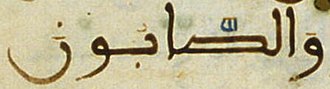
al-Ṣābiʾūn
An Arabic term referring to one of the ancient religious groups mentioned in the Qur'an, representing early monotheistic traditions connected to Abraham.
Stories & Illustrations
Visual journey through sacred narratives

#01
Abraham Broke idols, uphold One God.
Abraham's father was an idol maker. One day, young Abraham smashed all the idols except the largest one, then placed the axe in its hands. When questioned, he challenged his father: 'Ask the big idol - he did it.' This act of courage marked the beginning of monotheism.

#02
From three wives arise the bloodlines of five major religions.
Abraham had three wives: Sarah, Hagar, and Keturah. From their descendants emerged five major world religions: Judaism, Christianity, Islam, the Bábí Faith, and the Bahá'í Faith.

#03
In His Old Age, Abraham Offers His Beloved Son.
In the ultimate test of faith, Abraham was willing to sacrifice his beloved son at God's command. This act of complete submission became a defining moment in religious history.

#04
Father of Nations Whose Seeds as the Stars of Heaven.
God promised Abraham: 'I will make your descendants as numerous as the stars in the sky.' This covenant was fulfilled through his children, whose descendants formed great nations and religions.
Knowledge Quiz
Question 1 of 3
Score: 0
Where was Abraham traditionally born?