Buddhism
Origins & Timeline
Place of Origin
Ancient India
Northern India (Nepal/India border region)
Time Period
c. 5th century BCE
Era
The Axial Age
FROM
ANCIENT
TO
PRESENT
Buddhism arose around the 5th century BCE in northern ancient India, in regions including Kapilavastu, Bodh Gayā, and Sarnath. Emerging from the Ganges basin, it later spread across South Asia, East Asia, and Central Asia, developing diverse traditions.
* From one teacher's awakening, Buddhism spread to become one of the world's major religions with various traditions.
Śākyamuni Buddha
Born Siddhārtha Gautama
The Awakened One
"Peace comes from within. Do not seek it without."
1) Birth and Royal Background
Born in Lumbinī (present-day southern Nepal), of the Śākya clan. Raised in a royal environment with fine education and training. Traditional narratives emphasize his early reflections on impermanence and suffering.
2) Awakening Triggers
As a young man, he realized that even the most comfortable life cannot escape aging, illness, death, and loss. This prompted him to ask: Can one find a path to transcend suffering and fear, to attain true freedom?
3) Renunciation
He made a pivotal choice: leaving the palace and family to become a wandering ascetic—symbolizing the shift from pursuing worldly security to seeking universal truth and liberation.
4) Asceticism and Exploration
He studied under various teachers, learning meditation and ascetic practices. After rigorous austerities, he realized that neither extreme indulgence nor extreme self-mortification leads to liberation—thus proposing the Middle Way.
5) Enlightenment
At Bodh Gayā, beneath the Bodhi tree, he attained full awakening. 'Buddha' means 'the Awakened One'—he discerned how suffering arises, how it ceases, and the path to its cessation. This established Buddhism's core doctrinal framework: the Four Noble Truths and the path to liberation.
6) First Turning of the Dharma Wheel
At Sarnath, he gave his first teaching to his initial disciples—known as 'the first turning of the Dharma wheel.' This established the Noble Eightfold Path (right view, right action, right mindfulness, right concentration, etc.). The Sangha (monastic community) was formed and systematic teaching began.
7) Forty-Plus Years of Teaching
The Buddha traveled and taught throughout the Ganges region, addressing kings, merchants, farmers, and the poor alike. He established monastic discipline (Vinaya) and developed a complete system of practice: Śīla (ethical conduct), Samādhi (mental cultivation), and Prajñā (wisdom). He emphasized both compassion and wisdom: caring for all beings while guiding them toward awakening.
8) Final Nirvāṇa
In his later years, he continued teaching, urging disciples to 'take the Dharma as refuge.' He passed into Parinirvāṇa at Kuśinagara. 'Nirvāṇa' symbolizes the cessation of afflictions and freedom beyond the bonds of birth and death—not mere annihilation.
Core Briefs
Four Noble Truths
The Path to Liberation
Suffering exists (Dukkha); suffering has a cause (craving/ignorance); suffering can cease; there is a path to cessation (the Eightfold Path).
Noble Eightfold Path
Right Living
Right view, right intention, right speech, right action, right livelihood, right effort, right mindfulness, right concentration—training body, speech, and mind.
Dependent Origination
Pratītyasamutpāda
All phenomena arise through causes and conditions; nothing possesses an independent, eternal self-nature.
Karma & Samsara
Cause and Effect
Actions and mental states bring corresponding results, driving the cycle of existence.
Nirvana
Liberation
The cessation of afflictions and freedom beyond attachment and the cycle of birth and death.
Three Trainings
Śīla, Samādhi, Prajñā
Ethical conduct establishes the foundation; concentration trains the mind; wisdom perceives reality.
Compassion & Wisdom
Twin Pillars
Compassion cares for all beings; wisdom perceives truth. Both are cultivated together.
Theravāda
Way of the Elders
Emphasizes early texts and discipline, meditation and insight. The ideal is the Arhat's liberation. Core scriptures: Pāli Canon.
Mahāyāna
Great Vehicle
Centers on the Bodhisattva ideal—seeking awakening while benefiting all beings. Emphasizes both compassion and wisdom, with rich philosophical traditions (e.g., Prajñā/Emptiness).
Vajrayāna
Diamond Vehicle
Built on the Mahāyāna Bodhisattva path, emphasizing tantric practices: mantra (sacred syllables), visualization, mandala (symbolic diagrams), and empowerment rituals.
Regional Distribution
Geographic Spread
Theravāda: Sri Lanka, Thailand, Myanmar, Cambodia, Laos (South/Southeast Asia).
Mahāyāna: China, Korea, Japan, Vietnam (East Asia).
Vajrayāna: Tibet, Bhutan, Mongolia, Nepal Himalayas.
Sacred Scriptures
Theravāda
Theravāda
Based on the Tipiṭaka (Pāli Canon) as the foundational scriptures: Sutta Piṭaka (Discourses), Vinaya Piṭaka (Discipline), Abhidhamma Piṭaka (Systematic teachings)
"All that we are is the result of what we have thought."
Mahāyāna
Mahāyāna
Widely transmits numerous Mahāyāna Sūtras (Heart Sutra, Lotus Sutra, Diamond Sutra, etc.), forming systematic Chinese translated scriptural traditions in East Asia
"Form is emptiness, emptiness is form."
Vajrayāna
Vajrayāna
In addition to shared scriptures, emphasizes the Tantras and corresponding practice systems (particularly prominent in Tibetan traditions)
"The nature of mind is clear light."
Theravāda
Based on the Tipiṭaka (Pāli Canon) as the foundational scriptures: Sutta Piṭaka (Discourses), Vinaya Piṭaka (Discipline), Abhidhamma Piṭaka (Systematic teachings)
"All that we are is the result of what we have thought."
Mahāyāna
Widely transmits numerous Mahāyāna Sūtras (Heart Sutra, Lotus Sutra, Diamond Sutra, etc.), forming systematic Chinese translated scriptural traditions in East Asia
"Form is emptiness, emptiness is form."
Vajrayāna
In addition to shared scriptures, emphasizes the Tantras and corresponding practice systems (particularly prominent in Tibetan traditions)
"The nature of mind is clear light."
Sacred Symbols
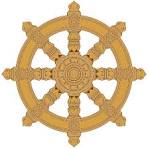
Dharmachakra
The Wheel of Dharma symbolizes the turning of the true teaching and the spread of the path of awakening. Its eight spokes represent the Noble Eightfold Path.
Lotus
Symbolizes purity, enlightenment, and transcendence—rising unstained from the mud, just as the awakened mind rises above worldly attachments.
Stories & Illustrations
Visual journey through sacred narratives

#01
Prince Siddhartha Encounters Suffering
As a prince, Siddhartha leaves the palace and encounters the realities of birth, aging, sickness, and death for the first time.

#02
Enlightenment Under the Bodhi Tree
Beneath the Bodhi tree, the Buddha meditates deeply for 49 days until he attains complete enlightenment.

#03
The Dharma Wheel
The Dharmachakra symbolizes the Buddha's teaching and the path to enlightenment through the Noble Eightfold Path.

#04
The Lotus Temple
The Lotus Temple (Bahá'í House of Worship) in New Delhi, India - a stunning architectural tribute to spiritual unity.
Knowledge Quiz
Question 1 of 3
Score: 0
What does 'Buddha' mean?